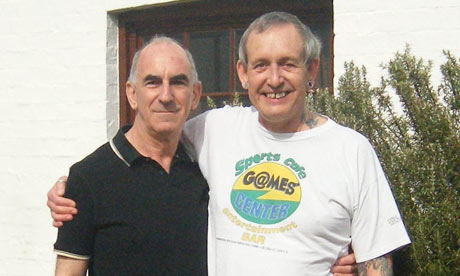
B&B refuse gay couple, police investigate

(Picture: BBC)

As a prime example of discrimination at work in modern day Britain, a gay couple visiting friends were turned away from a Berkshire Bed & Breakfast on the grounds of their sexual orientation, it emerged today.

Michael Black, 62 and John Morgan, 56 from Cambridgeshire, were refused a double bed at The Swiss B&B in Cookham, as police investigate what gay campaigner Stonewall has called 'an open-and-shut discrimination case'

The proprieter of the B&B Susanne Wilkinson admitted to the BBC that it was against her policy to accommadote same sex couples - a policy that breaches the Equality Act of 2006.

It is illegal for a business to refuse goods and services on the basis of sexual orientation, gender or race, and this case is no exception.

Mrs Wilkinson told the BBC:

"I don't see why I should change my mind and my beliefs I've held for years just because the government should force it on me.

"I am not a hotel, I am a guest house and this is a private house."

Mr Black has said that he was surprised at being turned away, having not experienced homophobia himself since coming out in 1974.

"This was the first time either of us had experienced homophobia at first hand, despite being aged 56 and 62. We were shocked and embarrassed.

"Mrs Wilkinson saw us both before we got out of the car and immediately acted in an unwelcoming, cold way, but my boyfriend and I were polite and friendly.

"She said if we'd told her in advance she would have told us not to come."

Thames Valley Police are looking into the incident.


This example is a real indication that discrimination is at work in Britain today. It is situations like this that highlight the importance of workable legislation that is committed to advancing the interests of all groups in society, and protecting them from bigatory, discriminatory and humiliating behaviour.

(In)Equality Bill

Following the House of Lords approval of amendments to the Equality Bill - allowing civil partnerships to be conducted on religious premises that are willing to perform the ceremony - there remain calls from gay rights activists concerning the level of protection offered in the legislation.

The Lords passed the amendment 95 to 21 in February, splitting the Bishops votes (with Bishop of Newcastle John Martin Wharton voting in favour of the decision). It is a step in the right direction toward a 'fairer future', or so Labour rhetoric would say.

Lady Butler-Sloss said in favour of the amendment:
"Same-sex couples can have strong and devoted relationships equal to, but different from, marriage and they may wish to have those relationships sanctified by a religious ceremony. If there are churches and synagogues prepared to do that, why should we stand in their way? They have rights to be loved and rights to have their ceremonies recognised."

Civil partnerships to be allowed on religious premises are supposed to represent a positive step toward recognising the rights of gay and lesbian couples to enjoy a spiritual ceremony. Yet as a legacy to earlier church opposition, a minister of any religion is still unable to lead a civil partnership service and no religious elements are allowed during the event in a means that join the two couples.

The amendment has also given fire to opponents of sexual orientation’s place in the Bill. As no obligation is placed on religious bodies to accept or allow civil partnerships at their premises, it is likely to cause more protest in the vein of ‘discrimination’.

The church will be in an awkward position between law and faith, and will potentially be victimised by this new amendment. Policy may have to go down the route of either making it a concrete law: religious premises MUST allow civil partnerships; or more likely, the legislation will be left stagnant in the light of inevitable discrimination cases.

The China case

After looking at my group member Yen's post, I want to continue our talking about LGBT rights.

I come from China which is a developing country, where homosexual marriage is illegal and homosexual rights have not been given enough weight. The two lesbians I met in my undergraduate study in China were looked down by classmates around them. Most people cannot understand why they chose the same-sex person as their life partners. I have no right or wrong attitude towards homosexual actions and I guess there must be reasons why they do not choose a heterosexual company as most people do.

As far as I concerned, the reason why the two girls I met in China prefer a same-sex life partner is that they lose confidence in men after being hurt seriously.

Lucky for me, our group's attempt to look at LGBT rights in Newcaslte gives me the chance to understand this topic more comprehensively.

In contrast to China, UK is a developed country where human rights are more respected. A good example is the Green Party's manifesto for the General Election this year that tries to fight for the rights of LGBT.

In UK, the gay and lesbian's activities are more open than in China. For example, there are gay bars, gay streets and gay societies in Newcastle. Gays and lesbians can make effort to fight for their rights. About their sexual orientation, I got an idea from our group members that those individuals are born with their preference in sexuality, they cannot control their feelings for the same-sex persons. But I don't know whether it's right or not.

Our group will continue to learn more about LGBT rights in Newcastle, hope we can have all questions answered and give a comprehensive look at LGBT rights in Newcastle.

A steep learning curve

Growing up in a country where homosexuality is a crime, I must admit that I have no knowledge about LGBT rights (I did not even know what LGBT stands for until I got involved in this project), and why there is a need for such rights.

No offence.

Prior to coming to UK, I did not know anyone who is lesbian, gay, bisexual or transgender in my country, Malaysia. I had not encountered any LGBT. I did not talk about LGBT. None of my friends did so (at least no one had discussed this topic with me before).

In Malaysia, LGBT rights do not exist. The laws also prohibit same-sex sexual activity - the penalty is up to 20 years in prison and/or fines and whippings.

Hence, getting involved in this project means a steep learning curve for me. When some of my group members were already talking about the "status" of LGBT rights in Newcastle, I was struggling with "Why do some people choose to be LGBT?".

Again, no offence. I do not discriminate LGBT. The lack of knowledge and understanding about this part of the community makes it impossible for me to even like or dislike them in the first place. I was brought up knowing that guys should love girls only and vice versa. Hence, the question of "Why do some people choose to be LGBT?" comes merely from my curiosity.

Homosexuality remains something I have not been able to comprehend since the first time I heard about "gays and lesbians", simply because I did not see the need to talk about this topic in my home country/community where few people are "out" enough to have discussions on LGBT.

Hence, it is with the involvement in this project that I hope I could learn more about the LGBT community and understand them better. I hope I could have all my questions about the LGBT answered. I believe that it is only when I can differentiate the facts from the myths then can I make sense of the whole notion of "diversity" in the society.

Looking forward to the "exploration".

Stay tuned :)